The Holy Cross Outcome: Graduates Prepared to Lead, Serve, and Thrive
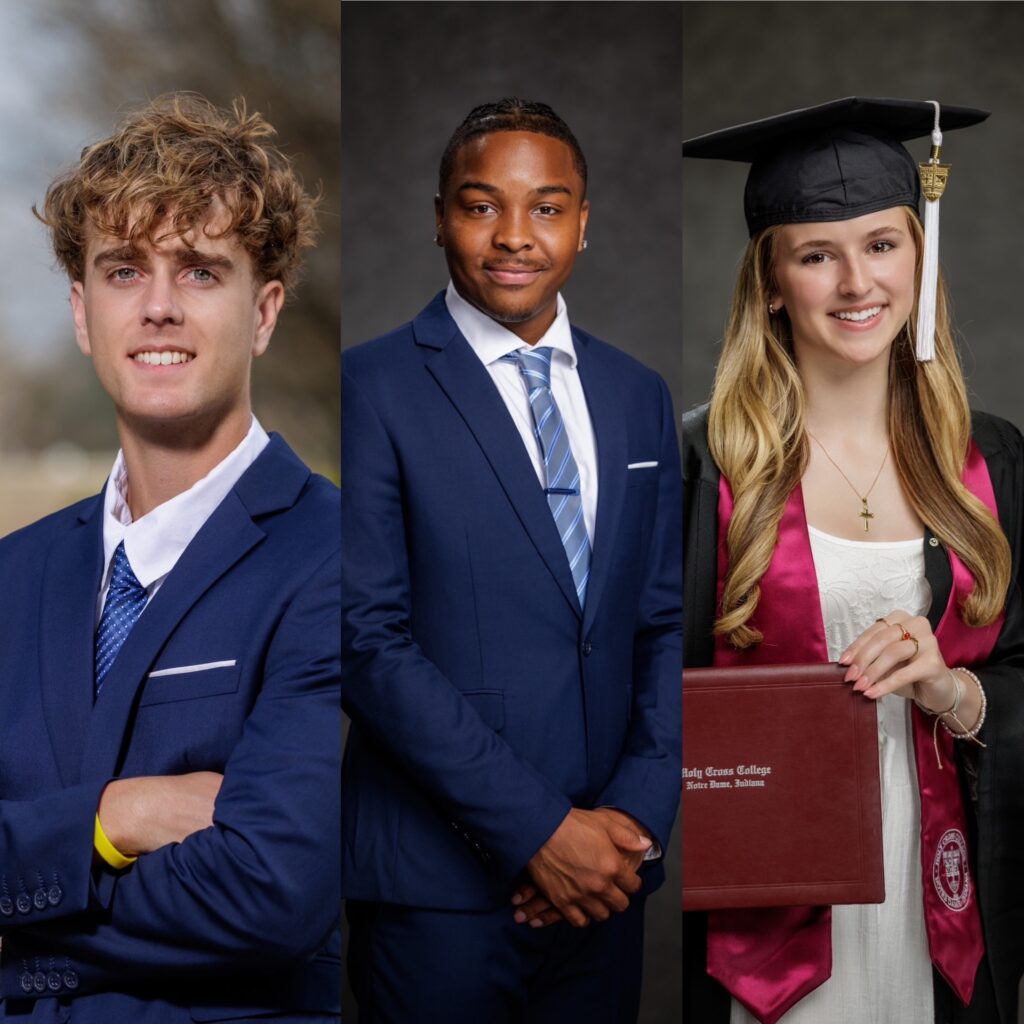
As Commencement 2026 approaches on May 16, three Holy Cross College seniors are helping define what outcomes look like when education is rooted in formation, mentorship, and purpose. From a future law student who discovered her voice beyond athletics, to the College’s first-ever Fulbright recipient, to a student-athlete whose resilience carried him from injury to national competition and graduate study at Notre Dame, Audrey Tallent , Jelani Cotton, and Hugh O’Sullivan each reflect the distinct journeys and transformative opportunities that shape the Holy Cross experience.
Click on each story below to go deeper into their Holy Cross College experience.
Meet The Holy Cross College Class of 2026
 By the time Hugh O’Sullivan arrived at Holy Cross College from Ireland, an injury had already changed everything.
O’Sullivan had committed to Holy Cross to play tennis after a national champioship youth career, but before he ever stepped on campus, he broke his leg playing Gaelic football in Cork. Instead of arriving ready to compete, he arrived carrying uncertainty, pain and the reality that the college career he imagined might never happen.
What followed was years of surgeries (14 to be exact), setbacks and rehab split between Ireland and Indiana. Complications mounted. At one point, nerve damage after a procedure left his foot hanging unresponsive.
“That was probably the lowest point,” he said. “I was so tired of it.”
Even Coach Eric Mahone remembers wondering how long O’Sullivan could keep going.
“It was probably like surgery number three,” Mahone said. “I was like, why are you doing this? You could go back home… what are you doing?”
O’Sullivan never gave a dramatic answer.
“That’s just what I’m doing,” Mahone recalled.
So he stayed. Mahone and O’Sullivan bonded and walked together, literally and figuratively.
And over time, Holy Cross became more than the place where O’Sullivan hoped to play tennis. It became the place where he rebuilt his future.
In the classroom, O’Sullivan immersed himself in demanding coursework in biology, chemistry and mathematics while balancing surgeries and recovery. Faculty members pushed him academically while supporting him personally, checking in during surgeries back home and making time whenever he needed help.
“I felt like I was seen,” O’Sullivan said. “They were in my corner.”
Mahone saw the same discipline academically that he saw during rehab.
“When you’re taking 21 credit hours and getting a 4.0, you kind of know he’s good,” Mahone said.
That work ethic and mentorship led O’Sullivan to research opportunities at the University of Notre Dame and eventually acceptance into Notre Dame’s ESTEEM Graduate Program, one of the nation’s leading programs in innovation, technology and entrepreneurship.
Even when he could not compete, O’Sullivan remained central to the tennis program. He became an assistant coach, helped recruit internationally and turned into one of the loudest supporters on the sideline.
“He could have complained,” Mahone said. “He just didn’t.”
Instead, teammates remember him banging crutches together courtside, creating energy and helping build the culture that transformed Holy Cross tennis into a national contender.
Eventually, after years of surgeries and rehab, O’Sullivan returned to the court himself. During commencement week, O’Sullivan also will compete with Holy Cross in the National Association of Intercollegiate Athletics Men’s Tennis National Championship tournament, marking the culmination of a journey that once left his playing future in doubt.
“It was emotional,” Mahone said of O’Sullivan’s return. “You knew what he went through.”
Now, O’Sullivan is preparing for nationals with his parents traveling from Ireland to watch him compete in college tennis for the first time.
“It’s a full-circle moment,” he said.
As graduation approaches, O’Sullivan’s story is no longer simply about perseverance through injury. It is about what became possible because he stayed: elite graduate opportunities, lifelong mentorship, leadership and proof that transformation at Holy Cross extends far beyond the court.
 When Jelani Cotton arrived at Holy Cross College, he knew he was going to college.
What he didn’t know was what that path would become.
“I didn’t know what I was going to do,” he says. “I just knew I was going to college.”
A South Bend native and first-generation student, Jelani came without a roadmap. What he found instead was something more personal: faculty and mentors who paid attention, asked questions, and stayed with him through the process.
That showed up in moments that became defining ones.
While studying abroad in Italy, Jelani risked losing his Spanish minor when the final course he needed was no longer available. A professor worked with him across time zones, adapting coursework and meeting outside normal class hours so he could stay on track, even when that meant logging in at 2 a.m. from abroad.
“He figured everything out,” Jelani says. “He wanted me to continue to keep building in the Spanish language.”
That same level of care extended beyond academics.
In a public speaking course, Laura Jackson helped Jelani grow in confidence. Over time, she became a mentor and source of support through deeply personal conversations and shared experiences outside the classroom.
“At a bigger school, they may not have known my story,” Jelani says. “Things like that were possible because of this college, because it’s smaller.”
Experiences like these changed how Jelani sees the world, including his own community.
Through service opportunities, internships, and coursework grounded in Catholic social teaching, he began to look differently at the people and places around him.
“I have a deeper compassion for marginalized populations because of Holy Cross,” he says. “They’re still human.”
That perspective is rooted in something personal.
“My biggest why is my younger cousins,” Jelani says. “I just want them to know that they don’t have to follow these paths… there’s so many other possibilities.”
That belief pushed him to take risks, including applying for the Fulbright Program on a one-week timeline with the support of Michael Griffin.
“I didn’t think it was possible,” he says.
Months later, Cotton became the first student in Holy Cross College history to earn a Fulbright award. The opportunity will take him to Spain to teach English while continuing the global learning experiences that first inspired him as a student.
“I didn’t have any examples of what I’m doing right now,” he says. “But I’m going to figure it out.”
In recent weeks, Cotton’s journey has been featured by OSV News, The Observer, and Inside Indiana Business, with coverage focusing on his Catholic formation, mentorship at Holy Cross, and commitment to serving others.
At Holy Cross, he was seen, supported, and challenged.
Cotton, a South Bend native, is the first student in Holy Cross College history to apply for and be selected for a Fulbright award, marking a significant milestone for the institution.
“Jelani’s achievement is a powerful example of what happens when talent, faith, and opportunity come together,” said Marco J. Clark, president of Holy Cross College. “At Holy Cross, we are committed to forming students who are ready to engage the world with both competence and conviction. His selection as a Fulbright Scholar reflects not only his dedication, but the kind of formation that prepares our students to lead and serve in a global society.”
 Audrey Tallent still remembers the jersey.
At a summer basketball tournament during high school, she had accidentally given her uniform to a substitute teammate who had forgotten hers. That left Tallent competing in a mismatched practice jersey, standing out on the court for reasons she never intended.
Holy Cross women’s basketball coach Tom Robbins noticed immediately.
“He called my coach later and said, ‘Who’s the one wearing that out-of-place jersey?’” Tallent recalled. “It was number seven. I still remember that.”
Years later, Tallent sees that moment differently. What began as a basketball recruiting connection became the start of a much larger transformation, one that carried her from student-athlete to student government vice president, philosophy major and future law student.
“When I got here, I expanded that a little bit,” Tallent said of her identity as an athlete. “I ended up doing so many different things. I think that my identity slowly changed through my four years here.”
Tallent arrived at Holy Cross expecting basketball to define most of her college experience, much as it had in high school. Instead, she found herself drawn into a campus culture that continually invited her to grow beyond what she thought possible.
That process began with relationships.
Her older sister, also a basketball player at Holy Cross, showed her how to approach professors, meet new people and become involved on campus. Coaches and faculty reinforced the same message: students here are meant to participate, lead and serve.
One lesson from Robbins especially stayed with her.
“He has a triangle pin where he’s at the top, but that doesn’t mean that he’s above everybody else,” Tallent said. “That means he has to serve everybody else. So seniors carry all of the luggage. The freshmen don’t touch anything.”
For Tallent, that culture of servant leadership reshaped how she viewed both athletics and leadership itself.
As a sophomore, she ran for student government senator largely because she thought it might help her resume for law school. Instead, it opened doors she never expected.
“I had kind of just been an athlete my whole life,” she said. “All of a sudden, I’m an athlete and I’m involved in student government. It was a good feeling that I had my identity outside of the basketball court.”
Eventually, peers encouraged her to apply for higher leadership roles within SGA, including chief of staff and later vice president.
“Someone pointed out these skills or different traits in me that would have done well in this position,” Tallent said. “Without that push, I probably never would have been where I am today.”
That encouragement extended into the classroom as well.
Tallent credits faculty mentors, including philosophy professor David Lutz, with helping her grow more confident in discussion-heavy courses and preparing her for law school. Though naturally shy, she learned to speak up, ask questions and trust her voice.
“It was kind of a non-negotiable,” she said of participating in class discussions. “You had to speak up.”
Faculty also worked closely with her to balance the demands of athletics, leadership and academics without lowering expectations.
“They never made it easier,” Tallent said. “They just helped me get to where I needed to be in a different way.”
That support became especially meaningful during the law school application process and while preparing for the LSAT.
“When people knew that I was taking the LSAT, they would check in with me after,” she said. “A lot of people offered prayer for the LSAT. It was emotional community support.”
Then came one final unforgettable moment.
On the bus ride home from the final basketball game of her career, Tallent received the email she had been waiting for: she had been accepted into law school at Indiana University McKinney.
Before calling family, she walked to the front of the bus and told her coaches and teammates.
“They were just so excited,” Tallent said. “Clapping, happy. It was fantastic.”
Now preparing for graduation, Tallent sees her story as part of a larger pattern at Holy Cross: students being seen, challenged and invited into possibilities they may not have imagined for themselves.
“I would have never taken that step myself,” she said. “And then someone pointed out these skills in me. Without that push, I hopefully never would have been where I am today.”