

Holy Cross Website Search
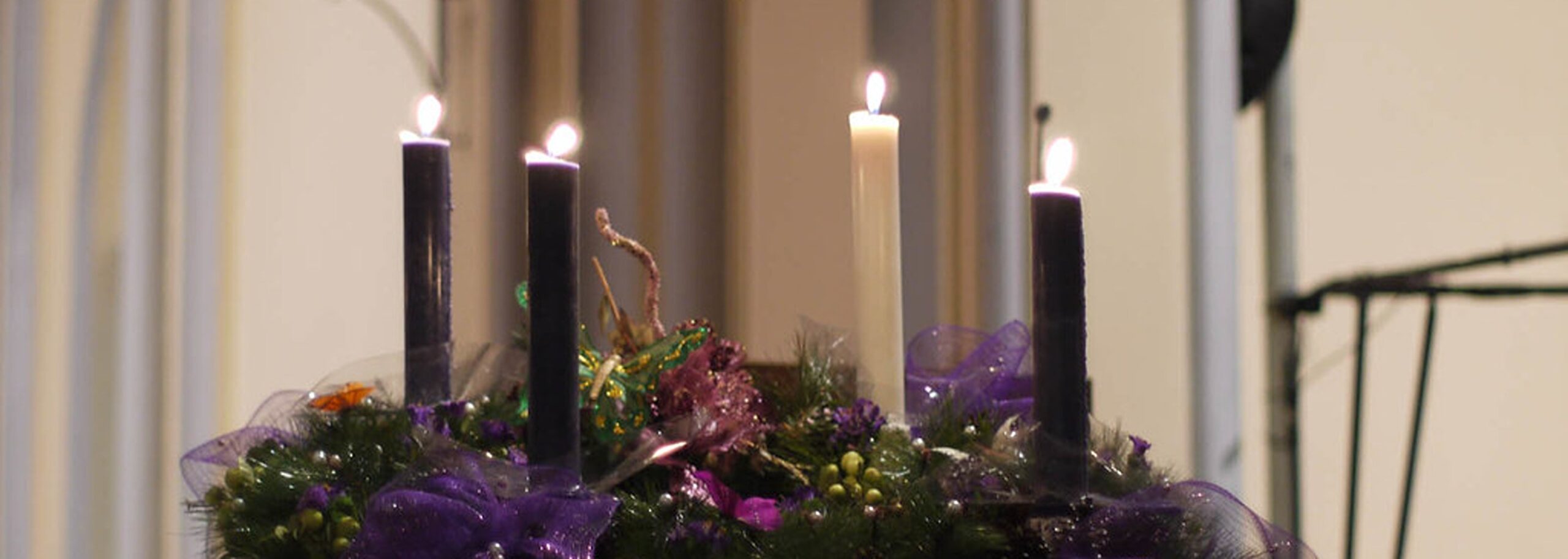
Advent invites us into a sacred season of anticipation—of watching, waiting, and hoping for the coming of Christ. This year, our journey is shaped by the ancient prayer “Maranatha,” a Greek expression meaning Come, Lord Jesus. More than a word, Maranatha is a plea, a promise, and a posture of the heart.
To pray Maranatha is to call upon Christ to come—to come into our world today with healing and justice, to come into our hearts with peace and renewal, and to come again in the fullness of His glory. It is a cry of hope for the future and a reminder to live each day in readiness for His return.
This prayer also turns our hearts toward gratitude. As we prepare for Christmas and remember Christ’s first coming in Bethlehem, Maranatha invites us to recognize where the Lord has already been at work in our lives. It encourages us to look back with thanksgiving, look inward with openness, and look forward with expectant hope.
As you enter into these Advent reflections, may this simple yet profound prayer guide your steps. May it awaken in you a longing for God’s presence and inspire you to help bring about the Kingdom of God here and now—even as we await its fullness.
Maranatha. Come, Lord Jesus.
By Monica Markovich, Executive Vice President and CFO
Waiting can be really hard.
Whether it is for something good – such as Christmas, Christmas break, a new child, or a new transition – or something harder such as for test results, health news, or the unknown. We often find our minds drawing toward anticipating the next things – whether they be good or bad. If we are anticipating something good, we might even long for it and wish for it to come sooner. If we are anticipating something more challenging, we might be filled with anxiety, fear, or dread. But all of that distracts us from what is happening right now, in the present moment with the present realities. It is exactly here, now, where we meet the Lord.
In 2021 I had the severe mercy of learning this through the surprise pregnancy and then devastating still birth of our 4th child, Tobias Maximilian. At 18 weeks pregnant we were shocked to learn this pregnancy was very dangerous for me, and only two weeks later to learn that Toby was also quite sick, and there was a chance that the pregnancy might not end well for either or both of us. Six weeks later, I delivered Toby into his eternal life. During those weeks, I learned to practice living in the present in a new way. I could not wish away the aches, the fear, the next appointment by wishing for the next day, because I did not know what the next day could hold for either of us. All I knew was that Toby and I had that day to meet Christ and to be Christ to others around us.
This is I think part of what Christ means when he says “Therefore, stay awake!” He will be in the future, but He is in the present and is asking us to be here too. We are not only preparing for Christ to come at Christmas, or for Christ’s second coming – but for Christ to come here, now, in this present moment and present day into our hearts wherever they are – to meet Christ in others, and to let them meet Him in us. Spaces of encounter can only happen when we are present to the moment. Do not let yourself be tempted to dream of another day or time, for it is today that He has given us to do His work of loving one another and letting ourselves be loved. Stay awake today, and encounter Christ.
By Samantha Derksen
The words “Maranatha, Come Lord Jesus” serve as a crucial spiritual reminder to resist complacency in the routines of everyday life – a challenge I keenly feel as a mother of two children under two, navigating the whirlwind of their schedules. The request to write this reflection truly felt like a spiritual alarm clock set by my colleagues urging me to “wake up!” because Advent is once again upon us.
Advent is meant to be a season of spiritual longing, but for the past four months my spiritual life has largely felt like a continuous act of sacrifice. Attending Sunday Mass as a family is a significant undertaking primarily because our toddler, Julia, prefers to run and play. My husband and I want her to be present with the community, which translates to a strict “no food, no loud toys” policy and the two of us relying instead on quiet Catholic children’s books and her little chewable rosary for engagement. Inevitably, one of us ends up standing in the back of the church, holding her while reciting silent prayers and hoping to find just a moment of peace.
Recently, after a particularly challenging Mass, as I was putting on Julia’s coat a mother with older children sitting behind us (whose children had kindly waved at and entertained my daughter during the Mass) took a moment to thank me for bringing my family to church. She expressed gratitude for our commitment and the sharing of that special time. Her kindness truly melted my heart.
That brief interaction was a gentle but profound reminder of the deeper significance behind bringing my daughters to Mass: it is not just a weekly commitment, but an intentional way of welcoming them into a vibrant community of believers. While the experience is sometimes demanding, I found deep comfort in the realization that countless parents and mothers before me have navigated similar struggles. Now their grown children are the ones attending Mass, often with their own children in tow, continuing the legacy of faith. This small moment affirmed the hope of the present and what is to come: “Come Lord Jesus.”
Being surrounded by peers, faculty, and staff in the Holy Cross community who are also striving to live out their faith creates a powerful “community of hope.” This shared journey and mutual support help in maintaining a vigilant and hopeful spirit, reminding me that I am part of a larger body of believers waiting for the fulfillment of God’s promises. The structure of this community provides constant reminders to “stay awake” and be prepared, ensuring that the true meaning of Advent, waiting in hope for the Lord’s coming, remains at the heart of the season.
By Jake Conn, ’27
When I hear Come Lord Jesus, I think of peace.
Peace of mind from the world that we live in and peace inside. When college and life seems to take place into so much of our lives, it gets quite busy to the point of not even being able to hear yourself. When you just hear yourself you hear the world. When you listen to God you hear the Holy Spirit and how he tries to cleanse your heart and mind. This leads me to prayer, when I hear Him- it draws me to be with him more because that is true inner peace.
When I pray for God to come into my life for Advent, I pray for him to help me make sacrifices, other people around me, and for the deeper needs of the world. Because living a selfless life requires to give oneself fully like Jesus did, and to live like Jesus is living life to the fullest.
Being part of Holy Cross deepens this mission by offering things like Rosary, night and morning prayer, mass and other various events. Being able to be surrounded by such a community has helped me get deeper in Faith and contributing to God’s mission.
I love that I can share my Faith and love for him freely at Holy Cross, it is one of the most beautiful things about this college and has made Advent so much better in my college years.
The Gospel for this past Sunday includes a phrase that makes me smile despite the apocalyptic backdrop of Christ’s second coming: “they were… marrying and giving in marriage.” Having just gotten married in August, I can relate to the Gospel in a new way and, more importantly, should be preparing for Christ’s second coming as we are still marrying and being given in marriage! Thankfully, that’s what Advent is for: preparation, hope, and waiting – an intentional slowing down.
Last week’s Thanksgiving holiday was the first with my new family which meant new traditions, long drives to and from Texas, staying purposeful to my wife and I’s collective prayer times and Mass attendance, and adjusting to a different pace and environment that’ll be carried through at least the next season of my life as we continue to alternate where we go for holidays. In the midst of the trip to Texas, we took a trip downtown on Friday where the holiday festivities were in full swing for Christmas. Santa was available for pictures, Christmas music was on in the shops, Christmas lights were out and about for viewing, and people were already wishing each other a Merry Christmas. Having not even reached the Advent season – it certainly seemed like we were already speeding up past the preparation and jumping straight to Christmas!
On the drive back up, I asked my wife, Elyse, what she would like to do for Advent this year, and we talked about the intentional steps we could take to prepare for Christmas including adding back prayer practices, limiting screen time, and postponing desserts among others. They’re small sacrifices meant to build us up, slow us down, and prepare for the joy that’s to come at Christmas.
Juan Maldonado
Associate Director of Academic Advising Operations
Come, Lord Jesus! This easily slides from our lips, but how often do we truly mean it? We who are afraid to talk about death are not thrilled about the thought of the second coming, but this is a mindset that we ought to change.
Death is nothing to fear; the end is nothing to fear. We must prepare, and if we do this, then we will never fear. We will have an intense hope that will permeate our entire life.
Questions arise. How do I prepare? How do I ready myself intentionally in a society that is so instantaneous?
Indeed, our whole life ought to be a preparation. We live well so that we might die well and in the state of grace. This life takes intentionality that is taxing, but think of it, the reward is eternal, and we are doing it for a God of love.
Every day I have the opportunity to prepare myself for His coming. He comes to me in the Eucharist every time I come to Him in the Holy Mass. “Behold the Lamb of God…I am not worthy that You should enter under my roof but only say the word and my soul shall be healed. Amen.” Then, He is with me. He is in me, and all the preparation seems worth any inconvenience it may be.
This preparation is a way of life. It means doing radical things for the Lord, always. It means being virtuous no matter the cost. It means sacrifice. It means truth. It means charity. It means “stay awake” (Matt. 24:42).
This preparation is very joyful and life-giving and fun. “Life with Christ is a wonderful adventure,” (JPII) and I hope that you get to experience this on a profoundly personal level during this Advent Season. Grow in intentionality of prayer so that you know the God of love whom you serve and so that you may welcome Him with a heart that truly is prepared to be His home this Christmas.
Come, Lord Jesus! This time I say it with conviction for this posture is the best way to prepare for His coming at Christmas and at the End.
– Elizabeth Pratt
As the first week of Advent gets going, the phrase “Maranatha! Come, Lord Jesus” brings up two big memories for me.
First, it takes me straight back to being a kid, when Advent basically felt like a countdown to Christmas morning. With every candle lit on the wreath meant I was one week closer to ripping wrapping paper with the speed and intensity of an Olympic sport. That childlike excitement, that almost-there!
And second… I can’t help but think of a particular parishioner from my home parish who, for reasons unknown to this day, always ended up sitting behind me during Mass, like a well-meaning liturgical shadow.
And during the song “Maranatha,” this person would absolutely LAUNCH that word into the air. Not just loudly, but heroically loud! Flexing far beyond the limits of what was previously known achievable by any human being to sing off-key… (you know who you are)
But honestly? Even that memory gives me a sense of joyful urgency, this “Hurry! Get ready!” energy that fits Advent perfectly.
In the Gospel for the first Sunday of Advent, Jesus says, “Therefore, stay awake! For you do not know on which day your Lord will come.”
Every time I hear those words, they hit me a little differently. I’m reminded, and yes, often convicted, of how easily I slide into autopilot. You know the mode: when you’re going through the motions, spiritually half-awake, thinking, “I’ll pray later… I’ll get serious about putting Jesus first when life calms down… I have time.” Spoiler alert: we don’t know if we have time.
Any moment could be that moment of encounter with Him. And if that’s true (and it is), then shouldn’t we want to be ready? Not in a panicked or frantic way, but in a joyful, expectant way, like those kids who basically vibrate with anticipation because Christmas is coming. That’s what Advent is supposed to ignite in us: not fear, not pressure, but anticipation for His coming.
So, as we begin this Advent season, let’s get ready together. Let’s shake off the autopilot mode, wipe the sleep from our spiritual eyes, and wake up to the moments God is giving us right now. Let’s stay awake, stay ready, and remain eager, so that whenever the hour comes, we’ll be more than prepared. We’ll be thrilled to go with Him.
And God willing, maybe when we finally do meet Him, He’ll smile and say, “I heard that parishioner behind you. They meant well.”
– Andy Rambadt, ’26
Christians have been fascinated by the coming of the Lord since our earliest days. In our collection of letters, epistles, and apocalyptic literature, the Aramaic imperative maranatha (meaning “Lord, come!”) stands out. It stands out because the New Testament was written and handed down in the Greek Language. Why, then, the inclusion of an Aramaic word?
The phenomenon whereby New Testament authors transliterated words from other languages (e.g., Aramaic and Hebrew) is not a novelty with the word maranatha. But what is a novelty is that it occurs only once throughout the entire New Testament, in the writings of Saint Paul. Writing to the community in Corinth, he issued the following warning: “If anyone does not love the Lord, let the one be accursed! Our Lord, come (maranatha)” (1 Cor 16:22). In other words, Paul is linking the coming of the Lord with his judgement of those who refuse to love the Lord that will return soon. In today’s Gospel, John the Baptist, though not using the word maranatha, appears championing a similar sentiment: “Repent, for the kingdom of heaven is at hand!” (Mt 3:2). Just as Paul commanded love of the Lord for those who await his return, so too did John proclaim repentance (metanoia)—an about-face of one’s inner thoughts and dispositions of the heart. Such repentance was central to the baptism John preached in anticipation of Jesus’s public ministry, and it remains just as crucial for us today as it was for Paul’s community in Corinth—living some two decades after the death, resurrection, and ascension of Jesus. Advent is a time given to us by the Church to prepare our hearts to receive Jesus anew into our lives.
This requires the love to which Paul called the first Christians with the phrase maranatha. Are our hearts ready to love Jesus abundantly when we remember his coming into the world as the little child of Bethlehem? And when we say maranatha, are we ready to welcome to Lord with love when he “come[s] again in glory to judge the living and the dead”?
Ever since I was a little girl, Advent has been my favorite liturgical season. I love the music, the candles, the violet and rose colored vestments, and the excitement of Christmas coming just around the corner. One of my favorite traditions is the Advent wreath. My family would put our advent wreath on the dinner table and before every dinner we would light the candles and sing “O Come O Come Emanuel.” As we ate and talked, we would let the candles burn. I look forward to this special time with my family every year.
While I still very much delight in the candles and songs of Advent, I have realized there is a deeper part to this season. In Advent we are waiting and preparing for the coming of Christ. This is what John the Baptist tells us in this Sunday’s Gospel. He tells us to “Prepare the way of the Lord, make straight his paths.” This is why we do all the things we do in this time. So, bring on the candles, sing all the songs, and get excited for Christmas to come again.
This is the season to prepare for Jesus to come again. There is an advent hymn I have come to love called “E’en so Lord Jesus Quickly Come” and it instructs us to “Rejoice in heaven, all ye that dwell within. Rejoice on earth, ye saints below, for Christ is coming soon!” Advent is a time for joyful preparation. Jesus wants to celebrate his birthday with you! You, Holy Cross Saint! He longs to be with you. He is standing at the door of your heart, knocking patiently. So, sweep away the dust and cobwebs of your heart, light a candle, prepare a path for Christ through the clutter and let Him in. The King of Kings comes to be with you. Jesus’s favorite time is when you let Him love you. He wants to rejoice with you. Let Him in.
Mary Appleton
Class of 2028
“Come, Lord Jesus! This easily slides from our lips, but how often do we truly mean it? We who are afraid to talk about death are not thrilled about the thought of the second coming, but this is a mindset that we ought to change.
Death is nothing to fear; the end is nothing to fear. We must prepare, and if we do this, then we will never fear. We will have an intense hope that will permeate our entire life.
Questions arise. How do I prepare? How do I ready myself intentionally in a society that is so instantaneous?
Indeed, our whole life ought to be a preparation. We live well so that we might die well and in the state of grace. This life takes intentionality that is taxing, but think of it, the reward is eternal, and we are doing it for a God of love.
Every day I have the opportunity to prepare myself for His coming. He comes to me in the Eucharist every time I come to Him in the Holy Mass. “Behold the Lamb of God…I am not worthy that You should enter under my roof but only say the word and my soul shall be healed. Amen.” Then, He is with me. He is in me, and all the preparation seems worth any inconvenience it may be.
This preparation is a way of life. It means doing radical things for the Lord, always. It means being virtuous no matter the cost. It means sacrifice. It means truth. It means charity. It means “stay awake” (Matt. 24:42).
This preparation is very joyful and life-giving and fun. “Life with Christ is a wonderful adventure,” (JPII) and I hope that you get to experience this on a profoundly personal level during this Advent Season. Grow in intentionality of prayer so that you know the God of love whom you serve and so that you may welcome Him with a heart that truly is prepared to be His home this Christmas.
Come, Lord Jesus! This time I say it with conviction for this posture is the best way to prepare for His coming at Christmas and at the End. “
Elizabeth Pratt
Class of 2028
“I never understood spring until I moved to South Bend a year ago. Growing up in Texas, winter was little more than a mild inconvenience. Glimpses of warmth were common and welcomed with open—and bare—arms. Here, the winter was not only harsher, but it dragged on into March and April. I began to forget what it felt like to not brace my whole being before stepping out my front door. I nearly lost hope that spring was on the other side.
When spring finally arrived, I embraced the warmth like an old friend. The trees began to blossom. I saw a gaggle of geese with their little goslings strut past my porch every day. I stopped bracing myself when I walked through my front door. Spring here filled me with a joy I had never experienced because it came after such a period of waiting.
Through my first experience of real winter, I understand Advent in a fuller light. As we wait for Christ’s coming at Christmas—and ultimately the Second Coming—we wait in a somber winter of repentance to prepare for the joy that is to come, and His Coming will be all the more joyful because of the wait that preceded it. But, we must remind ourselves of what we wait for or we will lose hope.
While we wait for Christ, we must look to the John the Baptists in our lives, the small springs in the midst of winter that give us hope. We are blessed with the ability to receive Him body, blood, soul, and divinity in the Eucharist and visit him frequently in Adoration. Unlike John the Baptist who merely paved the way for Christ and prepared others for his coming in today’s gospel, the Eucharist truly is Christ Himself and gives us a taste of a time when we can see Him not under the appearance of bread and wine, but in the resurrected flesh.”
Tim Roberts,
Admission Counselor
In Matthew 11:11-15, Jesus highly praises John the Baptist, claiming that “There is no one greater among those born of women than John the Baptist.” John the Baptist appeared to be the last Old Testament prophet and a bridge to the New Covenant. He prophesied to prepare the way for the Divine King and coming Messiah, who had already arrived and been baptized by John. Jesus was pleased with him, as his words are going to be fulfilled in Jesus. During this season of Advent, while we wait for our Lord’s coming, along with preparing our hearts, we are called to invite others to rejoice in the coming of the Savior.
We are called to be prophetic witnesses as our baptismal promises remind us that we share in Christ’s prophetic mission of the coming of the kingdom, enabling us to witness to God in the world. Like many other prophets, God wants us to be prophets of our day as our world longs for love and peace, and this love and peace can only be found in Christ, who is the source of love and Prince of peace. He is the savior who wants to come and heal the brokenness of our hearts. Aren’t we glad we have a savior who wants to save us when we are powerless to save ourselves?
In Isaiah 41:13-20, we hear God’s promising words, “I am the LORD, your God, who grasp your right hand, It is I who say to you, Fear not, I will help you.” Aren’t these words our hearts long to hear when we face challenges and uncertainties? In this short scripture passage, about nine times these words are used: ‘I will help you’… ‘I will make you’… God makes these promises to us to remind us that He is always there for us, especially in the times of joy and brokenness. He talks with authority, which assures us that He alone is our Savior, seeking to be born in our hearts in order to fill us with Joy and Hope. Come, Lord Jesus…
Urmita Rozario, C.S.C
Class of 2026
A common way to calm your thoughts and enter into prayer is to repeat a verse from scripture or phrase over and over in your mind. When your mind begins to wander or worry, you can come back to the words once more. When sitting in the chapel, whether for adoration or just a quiet time, I often turn to the Psalm “Be still and know that I am God”. I will let the repetition wash over me and slowly shorten the phrase, contemplating the words as a whole and on their own. The words will strike me differently based on what is happening on any given day but at the end always call me to just be with the Lord.
For advent, I have exchanged the Psalm for “Maranatha; Come, Lord Jesus Come” and invite you to give the practice a try. Head over to the chapel for a study break and allow the words to penetrate through the stress and busyness of finals season and see where you are asking Jesus to come. Do not be afraid to ask Him to come into any situation you find yourself in, be it stressing for your calc exam or the anticipation of being home for a few weeks and all that may entail, there is nothing too big or small to ask Jesus to come to. Afterall Advent is preparing us to remember the time he came into a meager manager out of his Love for us.
Come, Lord Jesus, Come
Come, Lord Jesus
Come, Lord
Come
Tricia McCarthy
Women’s Hall Director
Maranatha is one of my favorite words. It is an Aramaic word that loosely translated means, “Come, Lord.” Scripture scholars give us three potential meanings of the word: the Lord has come (past), the Lord is come (future), and Come, Lord (a cry for the present). The Church translates Maranatha into the phrase “Come, Lord Jesus” because we are invited to slow down and contemplate the three ways Jesus, as the Lord, comes to us.
The Lord has come. Here we are invited to wonder at the fact that Jesus, the Second Person of the Trinity, did in fact enter human history nearly 2000 years ago! I am in awe when I think about the fact that the One Who created the world (and us!) became like us so we can become like Him. He teaches, He heals, He restores, He unites, and He pays our penalty for sin. What an incredible God we have!
The Lord is come. Here we are invited to contemplate the promise Jesus gave that He will come again in majesty. The prospect of the Second Coming of Christ excites me. While it is sobering to think about the final judgement, it is exciting to think about Jesus coming back and kicking the devil and his demons into Hell forever, and reuniting Heaven and Earth. And I experience great joy when I think of life having no more sorrow, pain, or suffering. I relish in the thought of being reunited with those I love who have gone before me.
Come, Lord. Here we are invited to reflect on the mystery of the many ways Jesus breaks into our lives today. Between the power of the Holy Spirit living inside me, the gift of Scripture, the incredible grace of the Sacraments, connection with Him through personal prayer, and the experiences of His love and presence through community, the Lord comes to me and you through mysterious ways as only He can do.
Advent is a great time to slow down and clear out the clutter in our hearts and minds. For me, the current clutter in my heart and mind have largely to do with the sorrows I have had to carry this past year: my Mom passing away in early January, my uncle in March, followed by the passing of four friends in three weeks in late May/early June and another in August, as well as two immediate family members fighting cancer. Without the Lord’s grace coming to me in mystery or the promise of His coming in majesty, these sorrows could wreck me. But I have hope because of all that Jesus has done, continues to do, and will do. Today’s first reading, Isaiah 35, outlines that hope and so I once again say, Maranatha. Come, Lord.
Carolyn Kitz
Director of Student Activities
I am text block. Click edit button to change this text. Lorem ipsum dolor sit amet, consectetur adipiscing elit. Ut elit tellus, luctus nec ullamcorper mattis, pulvinar dapibus leo.
I’m embarrassed to confess that, though I have been a committed Catholic for my entire life, I never prayed evening prayer until I started graduate school.
The most integral activity in the life of Christ is His unceasing prayer, the eternal act of praise and thanksgiving of the Son for the Father. That unceasing prayer, the fulfillment of that most central mystery of the Trinity, is continued today in the Body of Christ through the Liturgy of the Hours.
Every “hour” of the liturgy affords a unique perspective into the Trinitarian mystery, but if you’ve never prayed it before, this week – the last week leading up to Christmas – is the perfect time to give it a try. You should start with evening prayer.
In every evening prayer, the Church echoes her mother’s song of praise, the Magnificat, when Mary rejoices with Elizabeth at the coming of her savior. This part of the prayer is preceded by an antiphon that changes each night, bringing into focus a different part of Mary’s song, or the gospel of the day. But this week – the last week leading up to Christmas – the antiphons are special. Starting tomorrow, we use the O Antiphons.
Each night, the antiphon begins by addressing our Lord with a different title. Each is a beautiful image of our Messiah, by itself worthy of prayer and reflection. They may be familiar to you if you are familiar with your advent hymns, or if you are familiar with the exterior facade of our own St. Joseph Chapel!
“O Wisdom…”
“O Key of David…”
“O Emmanuel..!”
More beautiful still, each antiphon ends with an exhortation. A plea.
Come.
“Come, and show your people the way to salvation.”
“Come, and break down the prison walls of death.”
“Come, and set us free.”
Join me, if just for one night this week, in praying evening prayer.
Together, let us beg our God, to come.
To be, with us.
Kyle Sherbert
Academic Director of the Computer Science
Come, Lord Jesus! Come into our lives just as you came into the world on that piercing cold night in Bethlehem.
Advent, at first glance, is a time to prepare for the season of Christmas. While this is the suitable time to do such preparation, the Church in her great wisdom asks us to prepare for our Lord’s coming in a few different ways. During Advent we not only look back at our Lord’s birth but also look at our own lives and what is to come.
Often, looking back on previous Christmas seasons, we rely on our senses to bring us the good memories of the festive season—one of which is sound. When thinking of Christmas, one would not dare forget the sounds of the season: carols sung while spending time with family, or the sacred texts of hymns being sung at midnight Mass.
Let us now remember a hymn so frequently sung at Mass during this holy time of Advent: “O Come, O Come Emmanuel.” This ancient text rings out the cry of Israel for the Messiah—the cry for the One who would fulfill the prophecies and the law: “O come, O come Emmanuel, and ransom captive Israel that mourns in lonely exile here…”
Singing this line, we unite our voices with this cry: Come, Lord Jesus! We plead for the Lord, already made incarnate in the world, to be incarnate in our lives. Let us have that same yearning for the Messiah to come into our hearts as Israel did for His coming.
As we prepare for the celebration of our Lord’s birth, may we make our lives a fitting place for the Lord to dwell. As we live this life with Christ in us, sharing Him with others, let us also have hope for life eternal. Living out this hope, we await the second coming of our Lord and anticipate the day when God appears on earth to reign, and all shall see the true Messiah.
“O come, O Key of David, come and open wide our heavenly home. Make safe for us the heavenward road and bar the way to death’s abode…”
As John in the Gospel for this week prepared the way for the birth of our Lord, may we prepare the way for Him to come into our lives and into the world again at the end of the age. Let us always have this cry on our hearts—the cry the Israelites had, and all of the saints to follow:
“O Come, O Come, Emmanuel!” Come, Lord Jesus!
Giovanni Zannino
Class of 2028
The Gospel this week discusses St. the Baptist’s role in salvation history. The quote, “Behold, I am sending my messenger ahead of you; he will prepare your way before you.” is directly tied to this Advent’s theme of Maranatha. The term Maranatha means “come, Lord Jesus”, but to me I see the term as preparation. While yes, we are asking Christ to come ad to be with us, we in turn must prepare our hearts to welcome Him. Advent is a time of preparation for the coming of our Lord at Christmas. We are to be like St. John the Baptist and prepare our hearts, but also those around us for Maranatha. The Gospel this week leads me to contemplate how I am preparing for the coming of Christ, not just at Christmas, but also the second coming.
My favorite way to prepare for the coming of Christ is to pray the Liturgy of the Hours, especially during the last week of Advent. The “O antiphons” are prayed during the Liturgy of the Hours during the last week of Advent, and they really help me prepare and contemplate Christ and his coming. These “O antiphons” (O Wisdom, O Lord, O Root of Jesse, O Key of David, O Rising Sun, O King of Nations, and O Emmanuel) really display the different roles and images of Christ. Praying with these different images of Christ aids me in seeing how Christ is truly connected to the Prophets, and it brings me hope in His second coming. My goal this Advent season is to always remember have hope in Christ. Romans 15:13 reminds us of the hope we should have in the Lord; “May the God of Hope fill you with all joy and peace as your trust in him, so that you may overflow in hope by the power of the Holy Spirit.”
Spencer Forslund
Admissions Counselor
Maranatha! This Aramaic phrase the Apostle Paul uses in 1 Corinthians, means “come Lord Jesus,” or can be translated “the Lord has come.” However, this phrase has a much more profound message: it invites us as children of God and a larger college community to draw closer to Christ’s love during this Advent season, and in turn reciprocate this same self-giving love to our neighbor.
In this week’s Gospel, while John the Baptist is imprisoned, he sends his disciples out to ask Christ if He is “the one who is to come”—that is, the Messiah Israel had been longing for to free them from Roman captivity. In response, Jesus tells John’s disciples to go back and tell him of the miracles they witnessed as a sign of his intent not to save Israel from human rule but from sin. John’s situation echoes our own “prisons” we put ourselves into in rejection of the healing power of Christ’s love. We look longingly through our “barred windows” within our hearts, continually wondering if this supposed Messiah truly is the answer to our pain, sorrows, and despair. We look to the lives of those around us who have witnessed and accepted His love, unlocking their hearts’ cages, and yet we simply wait, and for what? We have been let down by the world time after time that it creates a natural apprehension to trust someone so fully and makes it a truly frightening thought. But man’s folly is not Christ’s love nor intention for us. Rather, the “Word” became flesh and sacrificed Himself entirely in order to acquire humanity’s simple “yes” to His love.
Paul, earlier in Corinthians, warns that those who do not love the Lord are “accursed.” By rejecting Christ’s love, they sacrifice themselves to spiritual emptiness rather than allowing Christ to free them from the “prisons” they create that separate them from the love of others and God the Father. This Advent, we await the birth of our Savior. Yet, we must realize he has already come and patiently awaits for us to open our hearts to him. Let us not remain in the confines of sin, but allow His love to reshape us and share it with others through our words, thoughts, and actions here at Holy Cross–seeing others as the beloved sons and daughters of a forgiving Father. As we await our Savior’s birth, let us pray and invoke Maranatha, come Lord Jesus!
Rose Turnwald
Class of 2029
All things take patience.
It takes patience to prepare a meal for family and friends. It takes patience to decorate for the holidays. It takes patience to wrangle the kids to get anywhere on time. It takes patience when writing a paper. When we do take the time to be patient, we step back and are grateful and feel fulfilled at what has been done. Doing things fast and poorly leaves us feeling empty and unfulfilled.
We also have to be patient with ourselves. Maybe some of you, like me, feel we should be at a different spot in our lives or that there is more we can be doing if only we tried a little harder.
Advent and Christmas are good seasons to reflect and discern what the Lord is calling us to. This call to patience was highlighted in the Scripture in the third week of Advent readings; in James 5:7-10, the term “patience” is used four times, mirroring the four weeks of Advent—a beautiful reminder that patience is the central virtue we must cultivate as we await Christ’s arrival.
We cannot do everything. If you’re like me and try to jam too much in your schedule, you will feel tired and drained. We only have so much time in the day; use it wisely.
Let go and let God this Advent and Christmas season. Don’t jam-pack your schedule. Plan out what you need to do, but only if it is fulfilling to both you and God’s plan. Be patient and enjoy the waiting, as well as the festivities of the Christmas season.
Clare McNamara
Student Success Coach
The phrase Maranatha resonates with me as both a plea and a promise. When I hear it, I am reminded that Advent is not merely a season of waiting but of longing, expecting, and trusting that Christ continues to come into our lives in ways that are both quiet and meaningful. Maranatha allows us to hope for the future that God promises while asking us to transform ourselves into the ways Christ desires us to be. God calls all of us to be in the present moment with our hearts, our relationships, and our world.
Thinking about Maranatha also leads me into a natural, contemplative, and invitational prayer. It becomes a prayer that draws me to be still and to let go: Come, Lord Jesus… into my worries. Come, Lord Jesus… into my decisions. Come, Lord Jesus…into my community. When reflecting on The Gospel for the Fourth Week of Advent, I begin to center myself on Mary’s courageous “yes.” This reflection helps me to deepen my prayer by reminding me that God’s coming often looks like trust, humility, and a willingness to be transformed.
While we are preparing for the Lord’s arrival during Advent, we must remember to make space both internally and externally. For me, this looks like slowing down enough to notice where God is leading me, seeking reconciliation where needed, and choosing preparations that make room for joy, peace, and gratitude. One of my favorite family Advent traditions is lighting the candles of the Advent wreath each week. The growing light becomes a gentle reminder that even small acts of faithfulness can slowly illuminate the darkness, and that Christ, the light of the world, will forever dispel it. In the middle of our wreath is an empty creche, and each time someone does something selfless, they can put a piece of straw into the bed. The goal is that the creche will be full of loving acts, ready to receive Christ on Christmas Day. Some years, the creche is filled with straw, and some years, we are reminded that we need to work a little harder at caring for one another. I love this tradition as it has become a great visual representation of our Advent journey. Hopefully, by today, our creche is overflowing with straw.
Being part of the Holy Cross community also helps shape this season for me. Here, Advent is not just a personal journey but a communal one. Our shared mission of forming minds and hearts reminds me that Christ also comes through community, through welcoming each other with compassion, justice, and care. We walk alongside and accompany one another on this journey. In this shared life, we see glimpses of God’s Kingdom already unfolding among us.
Maranatha…Come, Lord Jesus. May our hearts, our homes, and our Holy Cross community be ready to receive Him.
Marie Laracy
Class of 2029
College life often feels like a mix of excitement and uncertainty. The difficulty of choosing a major, building friendships, navigating expectations, facing pressures we did not anticipate. In the midst of all of this, today’s Gospel offers an invitation: to let Jesus enter our lives the way Joseph allowed Him into his. Joseph in today’s Gospel is faced with a confusing and challenging situation, his future wife is pregnant. He decides to divorce Mary quietly, an understandable and appropriate course of action. But God calls him to do otherwise. An angel tells him: “Joseph, son of David, do not be afraid to take Mary your wife into your home.”
Despite the fear and unease Joseph feels, he accepts God’s call and allows God to penetrate his life in a powerful way. Joseph didn’t get the story he expected. He didn’t plan for the call God gave him. Still, he let Jesus enter his life. God often enters our lives in ways that interrupt our plans.We map out our every moment, thus not realizing the boundaries we put up towards Christ. We forget to allow His plans to penetrate into our lives. It is our responsibility to open our hearts to Jesus, no matter the call we receive from Him.
We, as a Holy Cross community, have a mission to fulfill this Advent season. Our mission is to live out Joseph’s example in our everyday lives, whether that be sacrificing our planned out schedules to spend time with a friend, putting aside time to pray and be with God, or simply opening our hearts to the possibility of a new vocation or calling. Let us, as a Holy Cross community, be like Joseph in the impending Christmas season and beyond. May we open our hearts to Jesus’ immaculate design in our lives.
Marie Laracy
Class of 2029
In the Gospel of Luke, “Mary said:
My soul proclaims the greatness of the Lord; my spirit rejoices in God my savior. for he has looked upon his lowly servant…”
I wonder, is my soul proclaiming the greatness of the Lord? Or is it also wheezing out an attachment to financial stability, to everyday comfort, and to hunger for personal success?
I have the urge to work on side hustles because I worry I won’t have enough money in the future for my family without debt.
I have the urge to listen to listen to provocative and depressing popular songs because they’re easily accessible on the radio and their popularity is inflated on streaming services.
I have the urge to claim credit to successes and hide away from mistakes.
How can I truly come to recognize the greatness of the Lord and His plan for me when I won’t stop worrying about the next thing on my overwhelming to-do list?
How can I rejoice in God’s saving grace when I keep putting myself down with both intentional toxic habits and allowing negativity to seep into my subconscious?
How can I be a disciple of Jesus when I am too busy staring at only myself in the mirror admiring my accomplishments and forgetting my neighbors?
In the spirit of today’s individualistic culture, I could go on and on about what problems I struggle with. And maybe some of my problems resonate with you. In the spirit of what we are called to do as Christians, I will urge you to turn to the Gospel in our life’s quest of finding answers.
One of the best habits I’ve practiced this year is incorporating the 12:25pm Daily Mass at St. Joseph Chapel into my daily schedule. I could read the Bible privately and imitate Jesus on my own, but then I would miss out on being alongside my brothers and sisters in Christ witnessing the miracle that happens almost every day on our campus which is the miracle of Jesus’ body, blood, soul, and divinity becoming present in the Eucharist!
I don’t regret rescheduling any of your meetings if they were originally set between 12-1pm (but I do feel sorry if they inconvenienced you that day). And I hope Holy Cross may once again rededicate the time between 12:25-1:00pm for Daily Mass so that all may have the daily opportunity to worship the Lord together. My favorite dismissal in Mass is “Go in Peace, glorifying the Lord by your life.” I pray that through our daily actions, others will come to know Christ. This is how we are called to proclaim the greatness of the Lord like Mary. If you don’t want to go to Daily Mass by yourself, I will always be happy to share my 2-person pew with you perfectly made for providing company. I, alongside Jesus and all the saints, hope to see you someday in the spring semester between 12:25-1:00pm in St. Joseph Chapel if you can.
Maria Gorecki
Assistant Director of Campus Ministry
The phrase “Maranatha, Come Lord Jesus” means more in this time than any. As we get closer to Christmas and the birth of Jesus, we are called to prepare our hearts to receive Him and all of the goodness that He brings into our lives.
This week’s Gospel occurs in a moment of waiting. Joseph knows that his life is about to change, but does not fully understand how just yet. At the start of the school year, we were in that same place. With our responsibilities as Resident Assistants and within Student Government, there was a lot that we were unsure about anticipating this school year. Whether that was making sure that the residence halls were ready for all of you, or making sure that our initiatives were student focused, we still had to realize that there would be some uncertainties along the way. Like Joseph, we were called to say “yes” in our own way, to the community and to ourselves. We are all called to say “yes” to the Lord, regardless of what the journey may entail.
With Joseph’s humble, yet guiding response, we are able to see everyday how we should live our lives, ready and willing to serve God in all that we do. Within the halls, we are called to create safe spaces for all of you, and within Student Government, advocating for all student needs throughout campus. No matter our roles, we are called to make space for others, regardless of the reasoning.
As we continue into this next semester and season of life, we reflect on Joseph’s openness to the call and prepare ourselves to welcome others with open hearts and compassion, allowing God to work through all of us.
As we continue to live out this prayer of Maranatha, we ask Christ to enter and bless our campus through leading, loving, and learning together.
Tori Piskol & Audrey Tallent
Student Body President & Vice President
Christmas blessings to you and your family. Over the past four weeks, we have been enriched by 24 beautiful and inspirational reflections, each preparing us for the coming of the Lord. On this Christmas Day, the Nativity of our Lord, the Word which was promised throughout Scripture, became flesh.
At the start of today’s Gospel, Jesus is identified as the Word of God: “In the beginning was the Word, and the Word was with God, and the Word was God” (John 1:1). In this gospel, St. John highlights the human nature of Jesus, emphasizing that Jesus became God in human form. John states that, “The Word became flesh and made his dwelling among us” (John 1:14). This is the incarnation, and as Christians we are called to be incarnational people.
To be incarnational people means to display divine qualities in tangible, real-world ways, in our everyday lives and in each interaction. As incarnational people, made in Jesus’ likeness and image, we are called upon to live our faith as courageous citizens, for this world and for heaven, deeply embedded in a sense community. We are challenged to lead virtuously with faith, hope, love, humility, compassion, and justice. In short, as passionate and hopeful disciples, we are called to be Christ’s visible presence in the world.
The founder of the Congregation of Holy Cross, Blessed Basil Moreau, emphasized that the incarnation is also an ongoing call for us to participate in Christ’s life, allowing God to transform our entire human experience into a journey of holiness and divine love. Through our words and personal witness, we make God known, loved, and served. This is what we call “the Holy Cross way.” In being Christ to others, the Holy Cross way is how we joyfully welcome, encourage, and walk side by side with one another, as teachers and leaders, bringing hope and healing to the world. It is a radical hospitality rooted in our Catholic faith and Holy Cross mission. It’s purposeful relationships and accompaniment on a campus culture of belonging, love, and respect for all. Echoing the words of John’s gospel, it is living fully alive, in grace and truth.
By the time Christmas break comes each year, after working and striving for a successful semester, I personally look forward to this season as a time for renewal, or to be re-incarnated. I pray that for you and your family that this time of year will also be a time for renewal and refreshment so that you can re-commit to living life as incarnational people, the Holy Cross way.
May God bless you all and may God continue to bless Holy Cross College. Thank you all for your love and support. Mrs. Clark and I will be praying that 2026 may bring you many blessings. Enjoy your time off and we’ll see you in the new year!
Dr. Clark
President