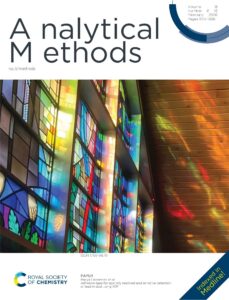
Holy Cross College Professor of the Practice of Chemistry, Zhutian Zhang, is a co-author on a newly published peer-reviewed study in Analytical Methods, a journal of the Royal Society of Chemistry, advancing practical approaches for detecting lead contamination in household and community environments.
Conducted in collaboration with researchers from the University of Notre Dame and Earlham College, the interdisciplinary project introduces rapid, field-deployable methods for identifying lead in dust, a hidden but persistent public health risk in older buildings, including historic parish spaces and residential areas.
By combining simple adhesive tape sampling with portable X-ray fluorescence technology and visual fluorescence testing, the research offers accessible tools that can help communities identify hazards and take action before exposure occurs.
Zhang worked alongside Holy Cross students throughout the project, giving them hands-on experience in community-centered scientific research that connects rigorous academic inquiry with service to the common good.
She answered questions about this work.
What problem does this research address, and why does it matter?
This research addresses the ongoing risk of lead contamination in older buildings, including historic parish spaces. Aging lead-based paint, deteriorating materials, and lead came used in stained-glass windows can generate lead-containing dust that poses serious health risks, especially for children.
In addition to identifying contamination risks, this work contributes to the development of improved analytical methods for detecting lead in dust. Traditional laboratory analyses can be accurate but require specialized equipment, time, and cost, while many consumer test kits lack reliability. This study evaluates practical field approaches — including adhesive tape dust collection combined with portable X-ray fluorescence (XRF) and a perovskite-based fluorescence test — that enable rapid, on-site screening at levels relevant to EPA action thresholds. These approaches address a long-standing need for reliable, accessible tools that can be used directly in community settings.
Rapid on-site detection allows hazards to be identified immediately, supports timely cleaning and maintenance decisions, and enables informed action before exposure occurs. Because lead exposure is often invisible, communities may assume spaces are safe when risks are present. Our work helps make hidden risks visible and supports practical steps to reduce exposure.
We also share EPA-aligned guidance for safe cleaning and remediation, since improper renovation or cleaning practices can increase lead exposure rather than reduce it. This issue is not only scientific; it involves public health, environmental justice, preservation of historic spaces, and care for vulnerable populations.
Students participate in this research as part of their scientific training, gaining hands-on experience while learning how careful measurement and responsible communication can protect community health.
Why is publication in a Royal Society of Chemistry journal significant?
Publication in a journal of the Royal Society of Chemistry reflects rigorous peer review and international scientific recognition. It affirms that the analytical methods developed and evaluated in this study are scientifically sound and contribute meaningfully to improved detection of lead hazards.
Because the research advances practical, field-deployable approaches for measuring lead in dust, publication in a respected chemistry journal helps ensure these methods can be evaluated, adopted, and refined by researchers, environmental professionals, and public health practitioners. Wider dissemination supports earlier identification of contamination, reduction of exposure risks, and improved lead hazard mitigation practices.
For our students and institution, it is especially meaningful to see research rooted in local community engagement contribute to the global scientific conversation. It demonstrates that careful work conducted in South Bend can have relevance far beyond our region and encourages students to see their efforts as part of a larger scientific mission.
What was your role in the study?
I contributed to the study’s methodology, field investigation, and data analysis. I collected dust samples from parish buildings, including sites with historic stained-glass windows, where aging materials can contribute to lead-containing dust.
I helped refine painter’s tape sampling and portable X-ray fluorescence (XRF) measurement procedures to improve accuracy and reproducibility in field conditions. This included optimizing how samples were folded and positioned, stabilizing the tape during measurement, and testing both sides to ensure consistent signal detection. These refinements strengthened the reliability of on-site screening in real environments.
In addition, I conducted ImageJ analysis of fluorescence data to evaluate a perovskite-based visual detection method, working with students engaged in the research. I also contributed to interpretation of the results and review of the manuscript.
How does this work reflect Holy Cross’s academic mission?
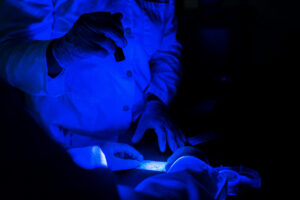
This project reflects Holy Cross’s mission by integrating rigorous academic inquiry with service to the common good. Students apply scientific methods to real community concerns while developing habits of responsibility, respect, and care for others.
In addition to testing, we provide EPA-aligned guidance to help parishes address contamination safely, recognizing that improper remediation can worsen exposure risks. This work connects environmental stewardship with care for sacred spaces and the well-being of those who gather in them.
The project also embodies Holy Cross’s call to the Courage to Act. Students confront a real public health concern and learn that scientific knowledge can be used to protect others and strengthen communities.
Collaboration with colleagues in art and theology further enriches the work. Discussions of stained-glass windows and sacred architecture deepen appreciation for beauty and heritage, while theological reflection connects environmental responsibility with stewardship, justice, and care for human dignity.
Through this interdisciplinary experience, students see how scientific knowledge can serve the common good and contribute to the flourishing of local communities. In this way, the work helps students grow not only as scientists but in character and responsibility. Character formation is at the heart of my teaching and research.
Can you speak on the collaboration with the University of Notre Dame
Our collaboration with the University of Notre Dame, especially with Dr. Marya Lieberman’s research group, has become a deeply formative partnership that benefits students, graduate researchers, and faculty and reflects Holy Cross’s mission of educating the whole person in service to the common good.
Through visits to Dr. Lieberman’s lab, Holy Cross students encounter research addressing urgent public health challenges, including paper analytical devices used to detect counterfeit medicines and fentanyl testing methods developed to support public health and law enforcement agencies. Seeing how chemistry can protect human life and serve society helps students understand the broader purpose of scientific work.
Students interact directly with Notre Dame graduate researchers and learn about research life, graduate school applications, and career discernment. One year, our undergraduate biology club hosted Notre Dame PhD students for a panel discussion that helped demystify scientific careers. These experiences have encouraged students to pursue research opportunities; for example, a former teaching assistant obtained a summer internship in a Notre Dame biology lab and is now applying to PhD programs.
The collaboration is reciprocal. Notre Dame graduate students have co-led sessions in my research courses, gaining mentoring and teaching experience while sharing their expertise with undergraduates. Ornella Joseph, lead author of the study, co-led for two years, and another graduate researcher led a general chemistry laboratory session at Holy Cross. These experiences helped participants explore academic vocations; Ornella and another member of the lab have since become college professors.
Dr. Lieberman invited our students to present at the Heavy Metal 2025 poster conference at Notre Dame’s Hesburgh Library and provided a workshop on effective scientific poster design. Presenting alongside researchers from multiple institutions strengthened students’ confidence and helped them see themselves as part of the scientific community.
At the conference, students also learned from a wide range of research topics related to heavy metal contamination, including studies of lead in ceramics, spices, soil, and water. Exposure to this broader work expanded their understanding of environmental health challenges and showed how analytical chemistry can address diverse real-world problems.
Dr. Lieberman has also been a generous mentor to me, offering guidance in research development, conference participation, and grant preparation. Her mentorship has strengthened our collaborative work and expanded opportunities for Holy Cross students.