
 A business can build wealth. The harder question, Thomas Gryp told Holy Cross College students, is what that wealth does for the people who helped create it and the communities the business serves.
“The question is not simply whether we can build wealth, but whether the wealth we build helps people flourish,” said Gryp, president and CEO of Notre Dame Federal Credit Union.
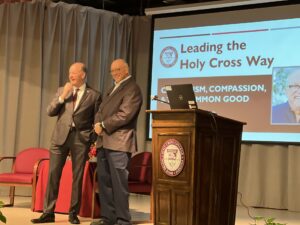
Gryp spoke Nov. 20 in Driscoll Auditorium as the final guest in this semester’s Leading the Holy Cross Way executive series with President Marco J. Clark. His talk, “Capitalism, Compassion and the Common Good,” asked students to consider what they want from their careers, how they will pursue it and whom their success will serve.
In the discussion that followed, Gryp offered an example from his own industry. He recalled a credit union CEO who was spending money trying to explain the difference between banks and credit unions. Members still couldn’t see it. Gryp told the CEO to look at how he was running the credit union and how people were treated when they walked in. Members would draw their conclusions from that experience.
That same attention to the people affected by a decision ran through Gryp’s advice to aspiring leaders. He urged students to consider what they would do with authority once they earned it, including when to give others the room to lead. He closed his talk with a prayer for “the compassion to see the person in front of us” and “the humility to release authority when others should own it.”
During the Q&A, business department chair Steve Varela asked how Gryp puts that philosophy into practice with his leadership team. Gryp’s response eventually turned to what students encounter in a Holy Cross classroom.
“Being here at Holy Cross College, you’re able to have conversations like this,” Gryp said. “You’re able to be in classes where conversations about ethics and what’s right and what’s wrong and Catholic social teaching is common.”
Gryp said Catholic social teaching shapes how he pays employees and how he shares authority at Notre Dame Federal Credit Union. He recalled asking the board to raise the lowest hourly wage to $15. The credit union also absorbed increases in health insurance premiums so employees could keep more of their raises. In the Q&A, Gryp said subsidiarity, which he described in practice as giving others the authority to make decisions, has been the hardest principle for him to live out. “Letting go is against our nature,” he said. “You have to fight it.”
Gryp closed with a prayer that offered a set of guideposts for attendees. He urged them to know when they have enough, find the courage to move beyond what’s comfortable, see the person in front of them with compassion, use capitalism in service of the common good and have the humility to hand over authority when it belongs with someone else. He ended by asking for “the wisdom to know when our ladders are up against the wrong wall.”
Gryp told students that learning the mechanics of business alongside those conversations gives them a way to think through the decisions they’ll face after graduation. He encouraged them to talk about those ideas now and put them to use while they have classmates and professors with whom to test them.
“So what you build here, what you plant, make sure it takes root,” he said.