 At Holy Cross College, students learn that real inquiry rarely happens in a single academic lane. The College’s distinctive, integrated curriculum encourages them to approach complex challenges through multiple disciplines, perspectives, and methods.
This five-minute feature video highlights one such project: a collaborative investigation into the presence of lead dust surrounding stained glass windows in local churches, a community-focused research effort led by Professor Zhutian (Tian) Zhang and supported by faculty from Chemistry, Theology, and Visual Arts, alongside collaborators from the University of Notre Dame.
Many older churches feature stained glass windows framed with lead caming (flexible strips of lead used to hold the glass in place). Over time, those structures can release microscopic lead particles, posing potential risks, particularly for children. Rather than discuss this issue in the abstract, Holy Cross students were supported in pursuing research that responds to real-world needs.
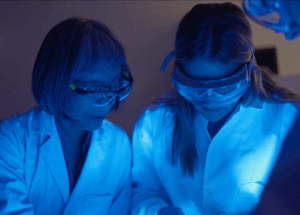
Professor Zhang guided students through innovative hands-on testing methods that allowed them to collect dust from window frames and surrounding surfaces in local churches. They then processed and analyzed the material in the laboratory, building the practical and analytical skills that underpin sound, ethical research.
But as the work progressed, students quickly learned that the science was only part of the story.
“As we go along with the project, the students and I realized pretty early on that the lead contamination problem is not just a science problem,” Zhang said. “It’s not something that can be solved only in the lab. It involves people, communities, communication, trust, and understanding how science fits into the real world.”
In keeping with Holy Cross College’s integrated learning model, faculty from Theology and Visual Arts provided essential context, helping students understand not only what they were testing, but why it matters historically, culturally, aesthetically, and pastorally.
Faculty in Theology helped students explore why stained glass has long held spiritual significance in Christian worship spaces, as storytelling media, sources of contemplation, and visual theology in color and light. Students reflected on the responsibility of caring for sacred spaces in ways that honor both tradition and the well-being of the congregation.
Faculty in Visual Arts provided insight into the craft of stained-glass fabrication, the role of lead in traditional window construction, and the long lifespan (and vulnerabilities) of these artworks. With artistic and material expertise, they helped students appreciate the delicate balance between preservation, safety, and the continued use of historical art in active parish communities.
Together, the three disciplines helped students see the issue from every angle: chemical, historical, spiritual, architectural, and communal.
“This project really helped students move beyond an isolated view of science,” Zhang said. “They started to see how research connects to other disciplines and how it plays a role in addressing real issues that people are facing every day.”
The results of the research offer practical guidance for churches seeking to maintain healthier worship environments. Students identified potential risks and recommended straightforward remediation practices, especially routine cleaning approaches that reduce dust accumulation. Their work joins a growing body of community-engaged research, conducted in partnership with Notre Dame faculty, dedicated to promoting healthier conditions for families and children.
This project embodies the mission of Holy Cross College: forming students who are competent in their disciplines, compassionate in their service, and courageous in their engagement with real needs.
“Research here is not about checking a box or completing an assignment,” Zhang said. “It’s about asking meaningful questions and understanding how what you are studying can make a difference beyond the classroom.”
By blending science, art, theology, and community partnership, this work demonstrates how interdisciplinary education empowers students to act with purpose, putting knowledge to work for the common good.