
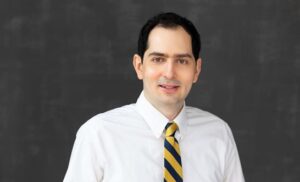
 Dr. Aris T. Alexandrou, assistant professor of biology at Holy Cross College, has co-authored a breast cancer study accepted for publication in Oncogene, a leading peer-reviewed journal in the Nature portfolio.
The study, “Functional deficiency of circadian regulator PER2 enhances breast cancer susceptibility and progression with immunosuppression,” explores how disruption of the body’s natural 24-hour cycle may affect the development and progression of breast cancer.
Alexandrou is the second-listed author and helped conceive the project. He also contributed to the study’s tumor modeling and immune cell analysis. The research brought together scientists affiliated with Holy Cross, the University of California, Davis, and several other institutions in the United States and China.
At the center of the study is PER2, a gene that helps regulate the body’s circadian rhythm. That rhythm influences familiar functions such as sleep, hormone release, metabolism, and immune activity. Previous research has connected disruptions in this natural cycle, including those associated with irregular sleep patterns, with an increased risk of certain cancers.
Through patient data and mouse models, Alexandrou and his fellow researchers found evidence that reduced PER2 function may make breast cancer more likely to develop, grow, and evade the body’s immune response. Their findings could help researchers better understand the connection between circadian rhythms and cancer while identifying new possibilities for future study.
Publication in Oncogene represents a significant scholarly achievement. The international journal publishes research advancing the scientific understanding of cancer and is part of Nature Portfolio, one of the world’s most recognized names in academic and scientific publishing.
Alexandrou’s work demonstrates the expertise Holy Cross professors bring to their fields and into the College’s academic community. It also reflects a culture in which faculty members remain actively engaged in consequential research while teaching and mentoring undergraduate students.
The study is expected to become available through PubMed later this fall.