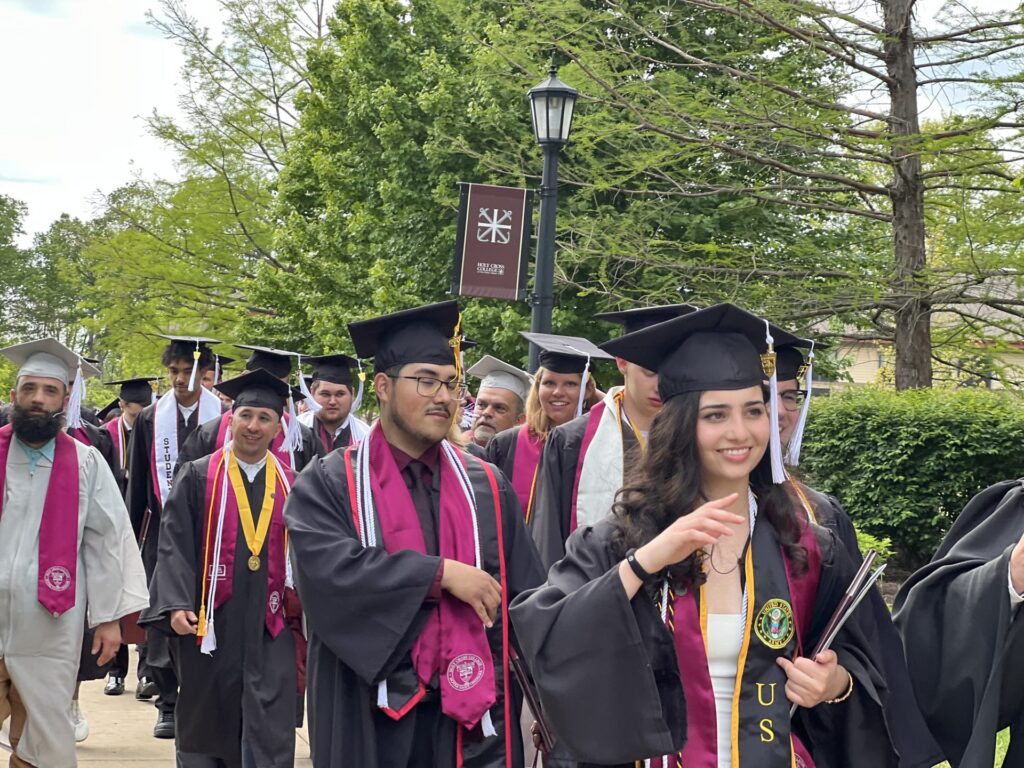
As members of Holy Cross College’s Class of 2026 crossed the stage during the College’s 59th Commencement Exercises on May 16, they celebrated more than degrees earned. Joined by commencement speaker Alex Jones, founder and CEO of the Hallow app, graduates were challenged to consider not simply what they will do next, but who they have become.
Across remarks from President Dr. Marco J. Clark, valedictorian Job Herrmann, and Jones, whose prayer and meditation platform Hallow has become one of the world’s most widely used faith-based apps, a shared message emerged: education is measured not only by achievement, but by the lives graduates are prepared to lead and the people they become along the way.
“The question is not simply what will you do,” President Clark told graduates. “The question is: who have you become?”
That question echoed throughout the ceremony as Holy Cross celebrated graduates entering graduate programs, military service, religious life, careers, and communities across the world.
“This class has grown as scholars, citizens, leaders, and disciples,” President Clark said. “I see them today and know they are hopeful and passionate disciples who are ready to make their mark on the world.”
The Class of 2026 represents students from 20 states and 11 countries. Nearly 45% will pursue graduate education, including at institutions such as University of Notre Dame, The Catholic University of America and the Indiana University Robert H. McKinney School of Law. Four graduates were commissioned as officers in the United States military. Others will enter religious formation, service opportunities, and careers across industries.
Among them is valedictorian Job Herrmann, a business major graduating with a 3.98 GPA. Following graduation, Herrmann will pursue a Master of Science in Accountancy through the College’s Pathways program at the University of Notre Dame.
Rather than focusing solely on academic accomplishments, Herrmann reflected on the mentors and faculty who shaped graduates beyond the classroom.
“Holy Cross is a remarkable place,” Herrmann said, “because we have not only been shaped by what was taught in our classrooms, but by the example of faculty who walked alongside us with care and dedication.”
Herrmann also offered a moment of gratitude and humor, recognizing faculty whose support extended into the everyday details of student life.
“Professor Thorpe,” he said, “if advising were a sport, you’d be in the Hall of Fame.”
The reflections reinforced a theme central to Holy Cross education: formation happens not only through instruction, but through accompaniment.
Jones, whose company Hallow has reached millions through guided prayer and meditation experiences, reflected on rejection, uncertainty, and entrepreneurship before urging graduates toward surrender and trust.
“The only thing I’ve learned is it’s just God waiting for me to let it go.”
Drawing from experiences building Hallow, Jones encouraged graduates to make room for silence, prayer, and openness to God’s work in their lives, reminding them that achievement alone does not sustain a person.
“The coolest part,” Jones said, reflecting on Hallow’s growth, “it’s not fundraising, it’s not downloads… It’s what He does in your heart.”
For Clark, the transformation celebrated at commencement carried a deeper meaning rooted in the Holy Cross mission.
“You came here one way,” he told graduates. “You leave another.”
Clark challenged graduates to carry faith, hope, and love into every vocation, becoming a different kind of teacher, lawyer, doctor, business leader, parent, religious, or community member, one formed not only for professional success, but for service and human dignity.
The symbolism became visible at the conclusion of the ceremony. After receiving their degrees, members of the Class of 2026 walked together across campus and passed beneath the Millennium Jubilee Arch, the same landmark many crossed as first-year students arriving at Holy Cross four years earlier.
This time, they passed through not as students arriving with uncertainty, but as graduates sent forward.
Degrees in hand, they carried something less visible as well: years of mentorship, formation, friendship, sacrifice, and faith.